





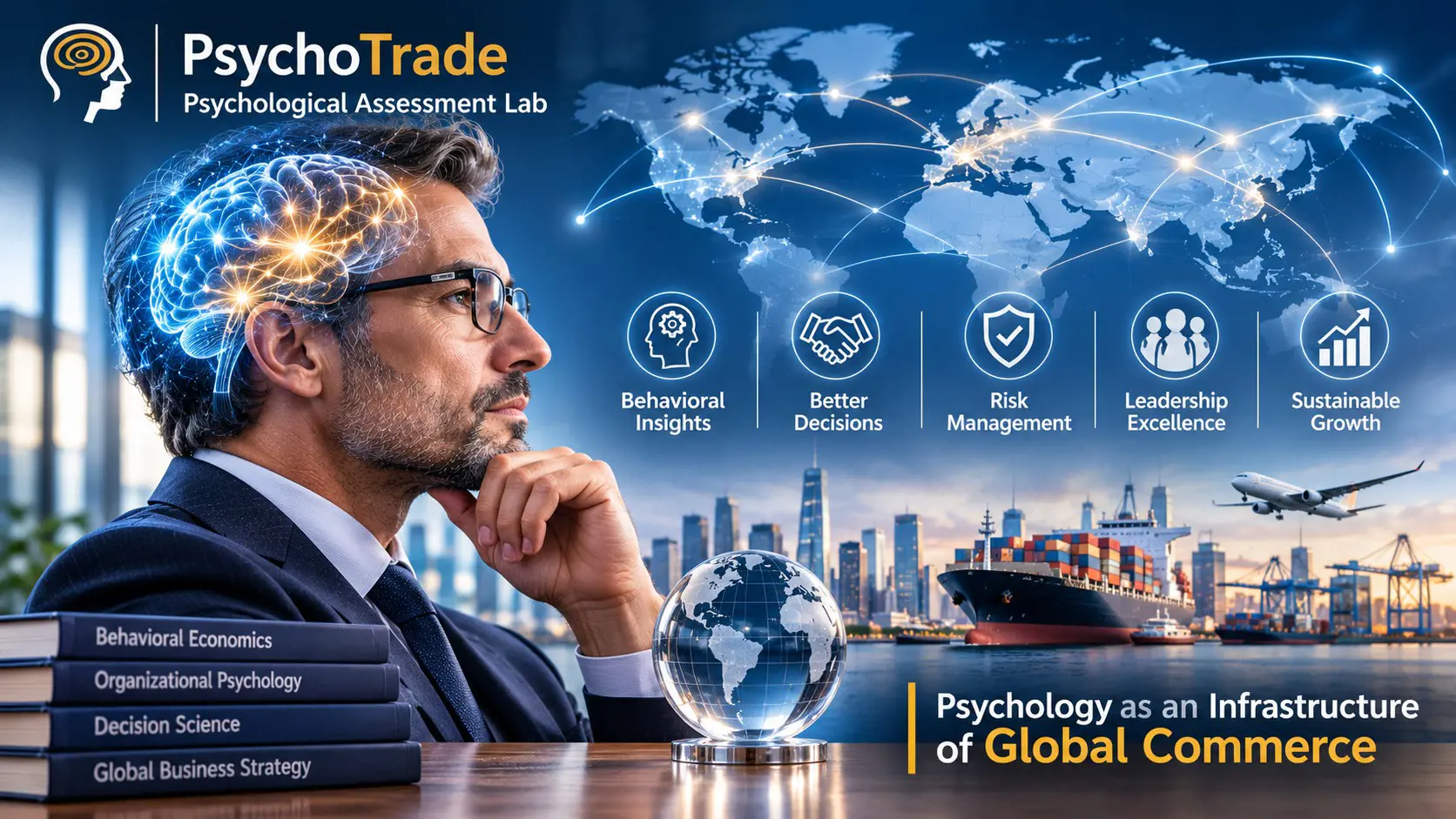
The Missing Dimension of Global Commerce: Why Psychology Must Become an Integral Part of Modern Business
For decades, commercial success has largely been evaluated through financial indicators, market positioning, operational efficiency, technological capabilities, and access to capital. Although these factors remain fundamental, an increasingly important dimension of economic performance has received insufficient institutional attention: human psychology.
Every commercial transaction, investment decision, negotiation, corporate strategy, and entrepreneurial initiative ultimately involves human judgment and behavior. Markets may operate through financial instruments, digital platforms, contractual arrangements, and sophisticated technological systems, but the decisions driving these mechanisms are still made by individuals and organizations whose behavior is influenced by psychological processes.
This creates an important question: Can modern commerce achieve sustainable efficiency without systematically understanding the psychological factors that influence its participants?
The answer requires a broader understanding of the relationship between psychology and economic activity.
1. The Human Factor Behind Economic Decisions
Economic decisions are frequently presented as rational calculations based on available information, expected returns, and measurable risks. However, actual human behavior does not always follow these assumptions.
Individuals may overestimate opportunities, underestimate potential losses, react emotionally to uncertainty, or make decisions influenced by previous experiences rather than current evidence.
Behavioral economics has extensively examined these deviations from traditional assumptions of economic rationality. Concepts such as loss aversion, confirmation bias, overconfidence, herd behavior, and anchoring demonstrate how psychological mechanisms can influence financial and commercial choices.
For example, an investor experiencing repeated losses may become excessively conservative, even when objectively attractive opportunities emerge. Conversely, an entrepreneur experiencing rapid growth may develop excessive confidence and undertake expansion strategies without sufficient risk assessment.
In both situations, the quality of economic decisions is influenced not only by market conditions but also by the psychological condition of the decision-maker.
Understanding this relationship is essential for improving commercial judgment.
2. Psychology and the Stability of Businesses
Business organizations are not merely collections of financial resources, physical assets, and operational processes. They are human systems composed of individuals with different motivations, expectations, emotional responses, ambitions, and behavioral characteristics.
Psychological factors influence organizational performance at several levels.
Leadership behavior determines how organizations respond to uncertainty, competition, internal disagreements, and strategic challenges. Employees' psychological conditions influence productivity, creativity, cooperation, and professional commitment. Meanwhile, organizational culture shapes how individuals perceive responsibility, risk, and accountability.
One particularly important issue is psychological exhaustion among entrepreneurs and executives.
Business owners frequently operate under prolonged financial pressure, responsibility for employees, uncertainty about future revenues, and the consequences of strategic decisions. Without appropriate psychological support and recovery mechanisms, these pressures may gradually affect concentration, judgment, motivation, and decision-making quality.
A financially viable business can therefore become vulnerable when its principal decision-makers experience prolonged psychological deterioration.
Business continuity requires more than financial recovery. It also requires the psychological capacity of individuals to continue making effective decisions.
3. The Psychological Dimension of International Trade and Negotiations
International commerce introduces additional psychological complexities. Cross-border negotiations involve different cultural expectations, communication styles, attitudes toward uncertainty, perceptions of authority, and approaches to trust-building.
A negotiation that appears commercially straightforward from a financial perspective may become complicated because of differences in expectations, communication patterns, or psychological interpretations.
For instance, one party may interpret prolonged negotiation as a sign of caution and professionalism, while another may perceive it as a lack of commitment. Similarly, different approaches to disagreement, hierarchy, and relationship-building can influence the development of commercial partnerships.
Understanding these differences can improve negotiation strategies, reduce misunderstandings, and strengthen long-term international business relationships.
Psychological awareness is therefore not simply an individual professional advantage. It is also a valuable component of international trade facilitation.
4. Consumer Psychology and the Architecture of Markets
Markets are shaped not only by the availability of products and services but also by how individuals perceive value, evaluate alternatives, develop preferences, and make purchasing decisions.
Consumer psychology helps explain why products with similar technical characteristics may achieve significantly different market positions.
Brand perception, emotional associations, social influence, trust, perceived quality, and purchasing motivation all contribute to consumer behavior.
For businesses, understanding these mechanisms can improve product development, customer relationships, marketing strategies, and market positioning.
However, the application of consumer psychology should be based on transparency and responsible communication rather than manipulation.
Long-term commercial relationships depend on trust, and trust cannot be sustainably established through psychological exploitation.
5. Financial Markets: Where Psychology Becomes an Economic Force
Financial markets provide one of the clearest examples of the economic consequences of collective psychological behavior.
Investor sentiment, fear, greed, uncertainty, overconfidence, and herd behavior can influence market movements and sometimes amplify price fluctuations beyond what underlying economic fundamentals alone would suggest.
During periods of optimism, investors may underestimate risks and collectively contribute to asset overvaluation. During periods of uncertainty, fear can accelerate capital withdrawal, increase market volatility, and intensify financial instability.
These dynamics demonstrate that market behavior cannot be fully understood through financial indicators alone.
A comprehensive approach to market analysis should consider both measurable economic conditions and the psychological mechanisms influencing market participants.
This is particularly important in an increasingly interconnected global economy, where information spreads rapidly and collective reactions can affect multiple markets simultaneously.
6. Psychological Resilience and Business Recovery
One of the most overlooked aspects of commercial development is the psychological recovery of individuals following business failure.
Bankruptcy, unsuccessful investments, commercial disputes, and the collapse of entrepreneurial projects can have consequences extending far beyond financial losses.
Such experiences may affect professional identity, self-confidence, risk perception, motivation, and the willingness to participate in future economic activities.
An entrepreneur who has experienced failure may either become excessively risk-averse or, alternatively, attempt to recover previous losses through increasingly aggressive decisions.
Neither response necessarily supports sustainable economic reintegration.Psychological recovery, objective evaluation of previous decisions, restoration of professional confidence, and the development of realistic future strategies should therefore be considered important components of business rehabilitation.
An economy that seeks to encourage entrepreneurship must pay attention not only to financing new businesses but also to restoring the decision-making capacity of individuals who have experienced commercial failure.
7. Toward the Institutionalization of Business Psychology
The increasing complexity of global commerce suggests that psychological assessment should gradually become an integrated component of professional business development.
Organizations can benefit from structured psychological approaches in several areas:
- Executive and Leadership Assessment: Evaluating decision-making patterns, leadership behavior, stress responses, and risk perception.
- Entrepreneurial Psychology: Understanding motivation, resilience, confidence, and behavioral responses to business uncertainty.
- Investment Psychology: Identifying cognitive biases and emotional influences affecting investment decisions.
- Negotiation Psychology: Improving communication, conflict management, trust-building, and cross-cultural commercial interactions.
- Organizational Psychology: Assessing workplace behavior, employee engagement, cooperation, and organizational resilience.
- Business Recovery Assessment: Supporting individuals and organizations in recovering from financial and commercial setbacks.
- Consumer Behavior Analysis: Understanding purchasing motivations, perceptions of value, and the psychological foundations of market demand.
These applications should be developed through scientifically grounded assessment methods, professional standards, confidentiality safeguards, and appropriate ethical frameworks.
Psychological assessment should complement, rather than replace, financial, legal, and operational due diligence.
Conclusion: The Future of Commerce Requires an Understanding of Human Behavior
The future of global commerce will increasingly depend on the integration of financial intelligence, technological innovation, institutional cooperation, and human behavioral understanding.
Artificial intelligence may improve forecasting, automation may increase operational efficiency, and financial infrastructure may facilitate international transactions. Nevertheless, none of these developments eliminates the psychological factors influencing the people who design, manage, finance, and participate in commercial activities.
The ability to recognize cognitive biases, understand behavioral differences, manage psychological pressure, and strengthen decision-making resilience can become a significant source of competitive advantage.
More importantly, it can contribute to reducing preventable commercial failures and improving the sustainability of economic relationships.
Commerce is ultimately a human activity operating through economic systems. Understanding the psychology of its participants is therefore not an optional advantage; it is an increasingly necessary condition for building a more stable, intelligent, and sustainable global business environment.
PsychoTrade Perspective: The next evolution of business intelligence must go beyond understanding markets. It must also understand the human minds that create, influence, and sustain them.